March 2, 2026 · 7 min read
The End of 9 to 5? Human Work in an Agent-Led World
In an agent-led working world, fixed office-hour models look increasingly outdated compared with outcome-driven orchestration.

By Peter Kirkup
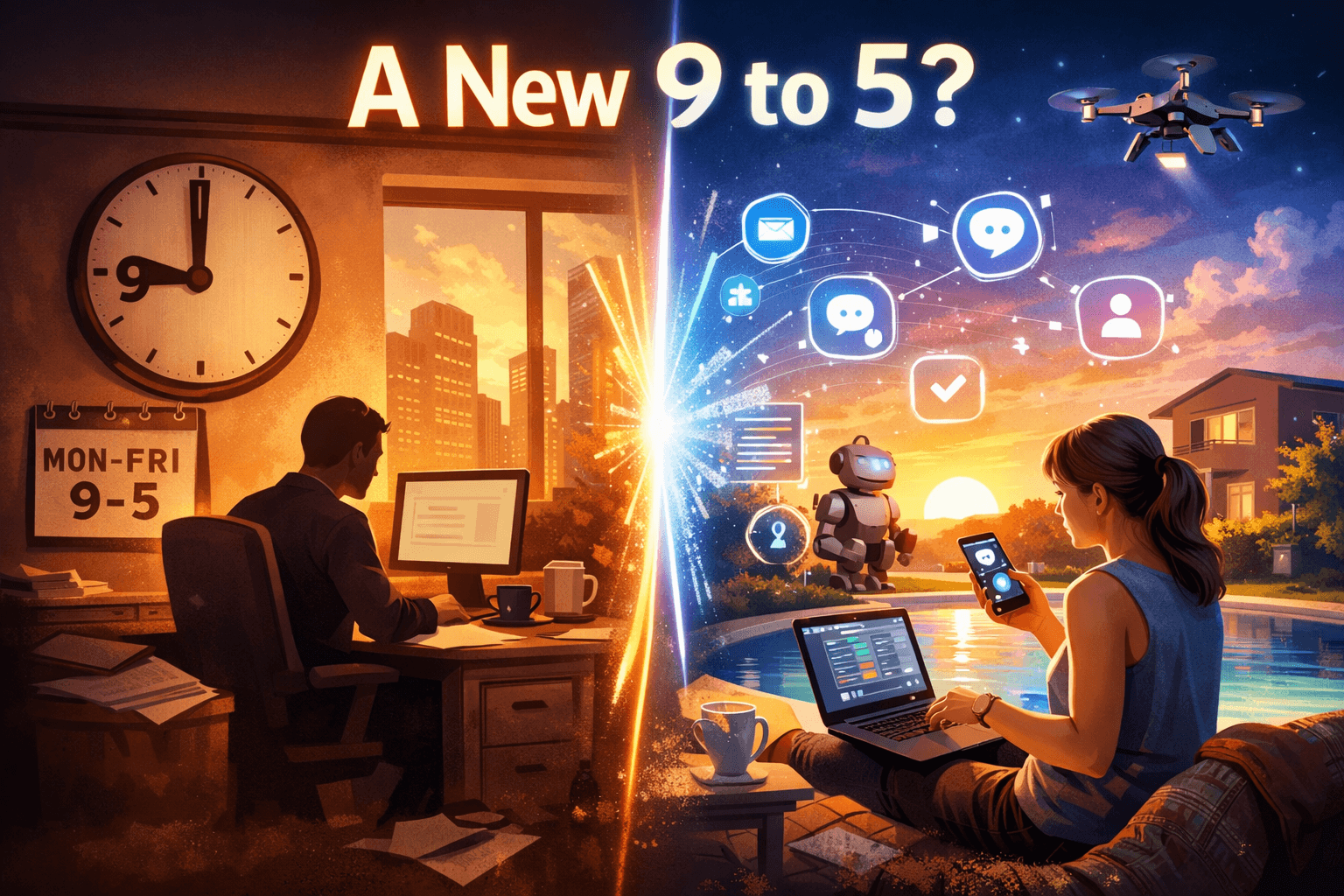
In the brave new world of an agentic-led work environment, does the 9-5 analogy make any sense?
The working world we know today, the 9-5 working day, 5-day working week, etc. - was largely a product of the industrial revolution (yet another thing we can thank Henry Ford for?). This is explored in depth in this CNN piece on 9-to-5 work culture, if you want more context.
Prior to the industrial revolution, our ancestors defined their own work days by the necessity of the tasks at hand - farmers woke at the break of dawn, bakers baked through the night to have their products ready for morning sales, and other trades and craft people could pick their own hours as their trade commanded.
The next industrial revolution
It seems more and more likely that we are entering our next revolution - a new world powered by agentic workforces led by human orchestrators. The recent explosion of desktop and cloud based coding agents - Claude Code, agent 'Claw' systems and automation through agents is already leading to workforce shifts and so it is natural that we should look at this new world and question the established norms.
The future of software engineering
It's already well documented that many experienced software engineers are no longer actively writing lines of code. Their skill, knowledge, and experience are now applied to orchestrating AI agents; prompting to create outcomes and then reviewing the results has become the new reality for software engineers. There are many articles already covering the 'death of the software engineer' - extreme but visible on the horizon as the role transitions to more of an orchestration role.
The work shifts from 8 hours of continuous coding to intense 20-minute 'sprints' of orchestration followed by 40 minutes of waiting/monitoring. It's in those gaps that life happens.
Working Space
Covid already proved to us that remote work is a viable option for a vast array of jobs. Practically overnight, office based 9-5 culture spread into our homes, and workplaces, people found routes to flexibility and the working environment shifted. No longer were teams chained to their office desk, but instead productivity continued through zoom calls, slack and all manner of online tools. In fact, even 6 years on, businesses have increasingly found themselves offering flexible work even where return to office policies exist - employees demand the flexibility to define their own working location, at least some of the time.
One of the justifications for return to office businesses is to encourage collaboration - managers and teams can more naturally collaborate when conversation is fluid and not found in the 16:9 window of a teams call. That's totally valid and largely work has returned to some sort of normal, where even fully remote colleagues spend periods of time in a physical office to enable focus and collaboration.
But with agentic workforces onboarding fast, we should probably question everything we know about the working environment - what does 9 to 5 look like, do agents need weekends and does it even make sense to be in an office?
Working Patterns
Harvard Business Review recently wrote about the effects of AI in the workspace, where employees are voluntarily pushing themselves to work additional hours, fuelled by the dopamine hits their agentic colleagues deliver after every successful task in AI doesn't reduce work, it intensifies it.
Perhaps it is time to rethink - as an orchestrator of agents, our role is to manage, observe, coach and evaluate their work. Being glued to a desk whilst agents do their busy work does not make much sense.
It is fair to say that an individual can probably at most manage two to three concurrent software projects. The cognitive load of keeping multiple tasks and status in mind, evaluating and confirming functionality is likely to top out there even for the most powerful multi taskers.
With that in mind, let us imagine what a world for a software orchestrator of the future could look like.
Working patterns could shift, with personal and business lives much more naturally intertwined than we have been experiencing since the industrial revolution. As a Software Orchestrator, imagine you spend some time crafting the perfect prompt, then launch a task to be handled by agents. What if you could then context switch to your personal life whilst the agents do their thing? Pop back from time to time and monitor their progress, or even wait for a ping on your mobile device, then tweak the prompt and set them off again, then switch back to personal mode whilst the agent makes their next iteration of the task.
In many ways, agentic orchestration could enable a more balanced world where work and social intertwine into a more homogenous experience, with focus and activities in your everyday life shifting throughout the day. The time enabled by an agentic workflow could even lead to new hobbies or side careers, perhaps an artistic renaissance is just around the corner?
Measurement
It is a whole new world for employers used to structuring work around a perceived productivity zone of 9-5. We have been socialised into believing work happens in these hours, and often reward people going above and beyond by pushing additional hours, yet in this new world the agents can work 24/7 and the dopamine is likely to draw employees towards extended hours.
Performance monitoring and billing will need to shift to task based rather than working hours. How do you price a work contribution where a prompt takes 10 minutes to construct but leads to $10,000 of incremental business value after the agent has delivered its outcome? If your agents are busy and being productive, does it matter to your employer if you are sitting at a desk, painting the next masterpiece or out weeding the garden? Being employed to deliver an outcome is not unusual, but manifesting that in when you show up and how you are rewarded is all part of the future world of work.
The risk: always available, always working?
There's a real risk with this new agentic capability that employers will expect employees to just carry on as they are - working traditional business hours, plus volunteering overtime to continue work, which could lead to a very unhealthy working environment.
As covered in the Harvard Business Review and also in my article Dopamine, there's a real sense of desire to keep going that comes from the use of agents. It should be obvious that this is unsustainable and could rapidly lead to burnt out, unproductive, unmotivated employees. Burnt-out orchestrators write poor prompts, miss defects in agent output, and ultimately cost the business more than they save. That's not good for any business, and so we have to meet this changing working environment with a change in approach.
Employees increasingly have a right to disconnect from their job - but does that disconnect have to look like a 5pm clock out? Normalising a new working style that means employees can comfortably contribute when their value is greatest, yet also exist in a life outside of work, will create a healthy balance between company and employee needs. There will be obligations - meetings aren't going anywhere - but the increased flexibility could create a new paradigm for work.
The experience paradox
There's a tension between an employee's experience and their willingness to push beyond standard hours. More senior employees tend to have more complex lives which would be better suited to the new working culture proposed. Junior employees may feel they can prove themselves by pushing beyond the expected hours, iterating on prompts, burning tokens but also creating an unhealthy space for themselves in the process. This paradox deserves its own exploration - watch this space!
Async work culture
As we explore the working culture, we have to ask - does a five day working week even make sense? If a long running agent task finishes at 11am on a Sunday, could a quick review and response from a mobile app enable the next round of work to continue? Right now that would be overtime, but what if we normalised it?
Multinational businesses already handle async work across timezones through internal tooling - why not lean into that and enable it for all workers?
Conclusion
In this brave new world, our blended workspace and personal life leaves plenty of room for social and traditional weekend activities to happen at any time - picking and choosing the right moments rather than needing to be tied to a fixed schedule.
We know there are going to be fundamental workforce changes in this new industrial revolution - let us set ourselves up for a place where we benefit from the additional time, rather than chaining ourselves to a desk to meet hours defined by Henry Ford in 1914.